Pular para o conteúdo principal

Engineering AI Evaluation

ElectroBench

Evaluating frontier AI models on code-graded electrical engineering simulation tasks.

Blind evaluation at a glance

Frozen tasks · numerical grading with engineering tolerances · Docker runner/grader isolation

Indicator Result
Frozen blind tasks 12
Attempts per condition 5
Blind baseline 18.3%
With official documentation 50.0%
Documentation + repair 60.0%

Key figures

Architecture, condition pass rates, per-task outcomes, and failure modes from the frozen blind evaluation.

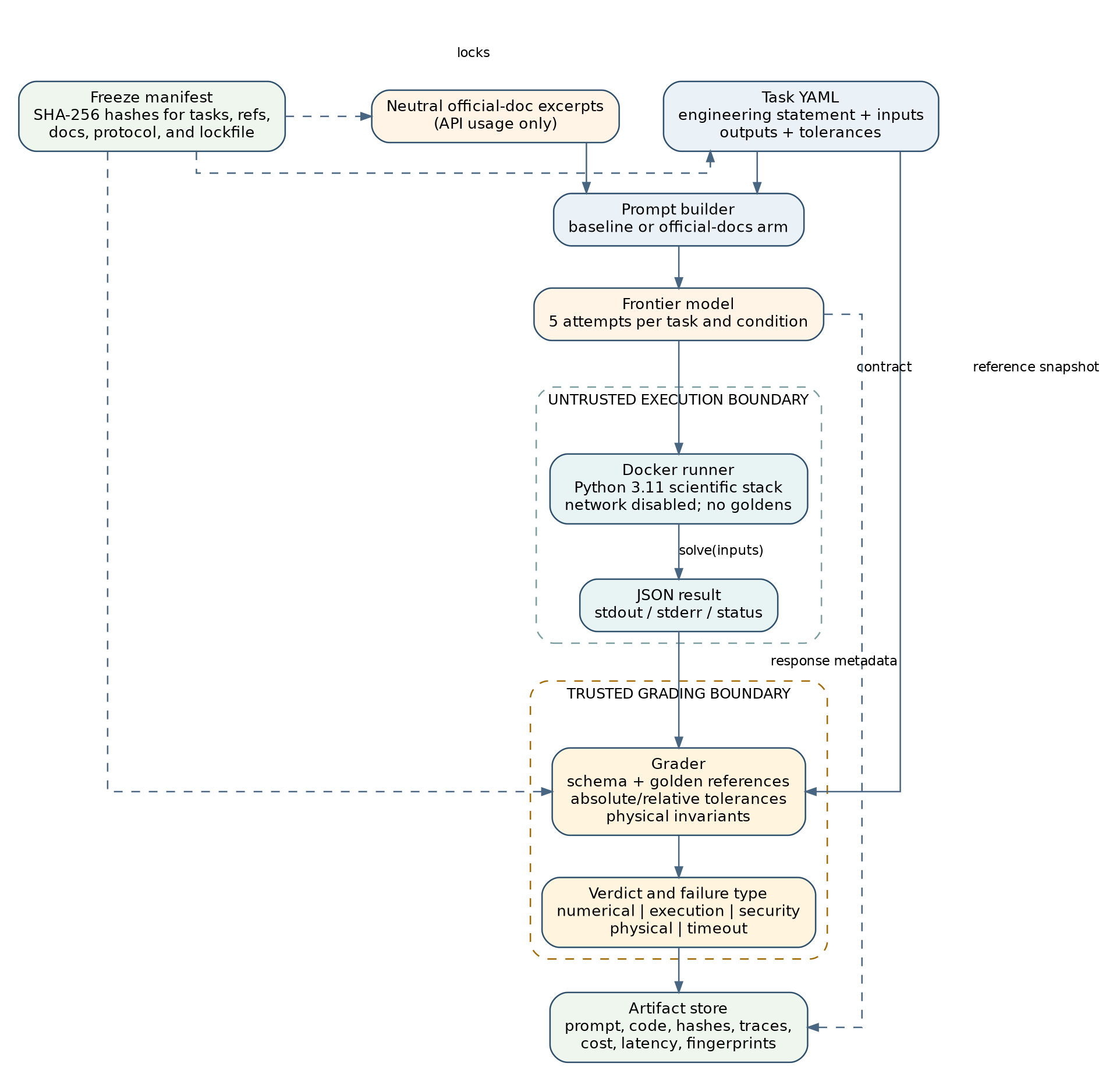
ElectroBench runner and grader architecture diagram
Runner / grader architecture with isolated Docker execution.
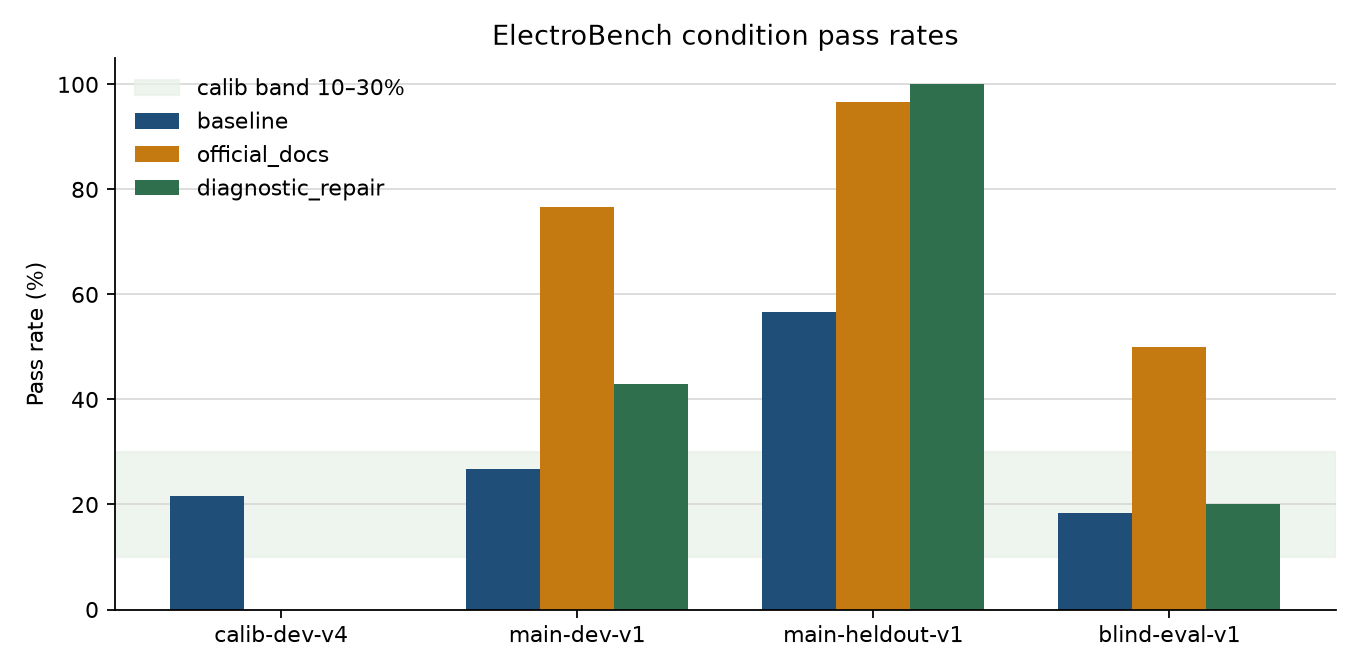
Pass rate by evaluation condition for ElectroBench
Pass rate by condition: baseline → documentation → documentation + repair.
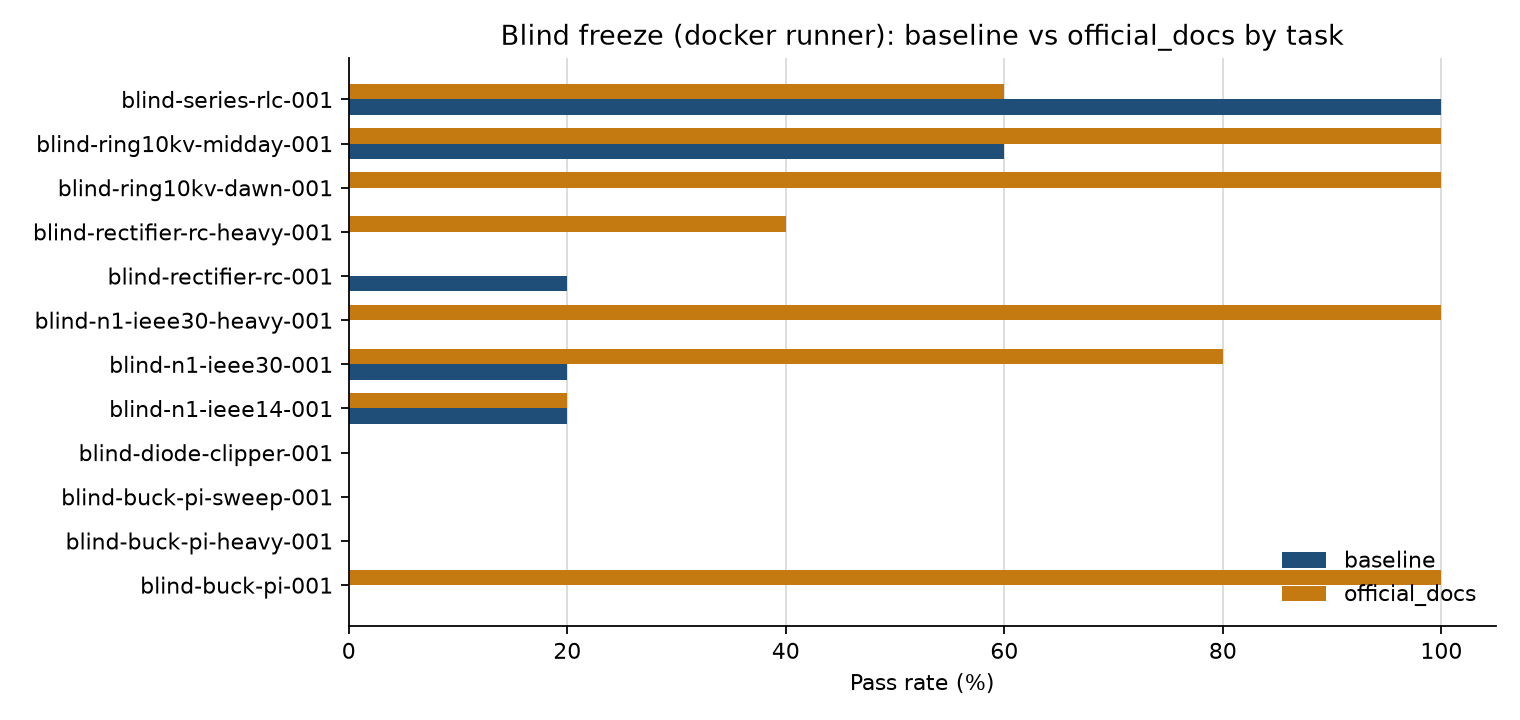
ElectroBench blind evaluation results per task
Blind results by task across control, power systems, and circuit families.
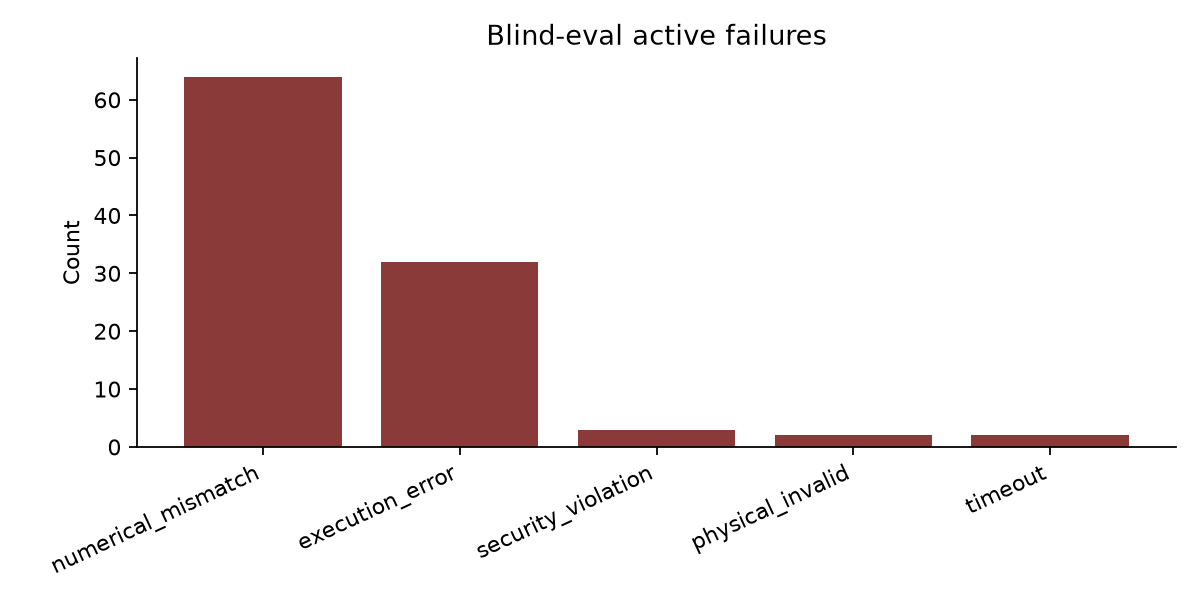
ElectroBench model failure type breakdown
Failure breakdown: numerical mismatch, execution error, and related modes.

Project summary

Five blocks. Pick your depth from here.

What I built

A reproducible, code-graded benchmark that asks models to generate Python solve(inputs) → dict solutions for electrical engineering simulations. Tasks span power systems (pandapower), control systems (python-control), and circuit modeling (SciPy-graded waveforms, with ngspice CLI integration smoke-tested in Docker). Candidate outputs are graded against frozen references with engineering tolerances, physical-validity checks, and separated Docker runner/grader environments.

Why it matters

Textual plausibility is not enough for simulation-heavy engineering work. A model can sound correct while using the wrong API, failing to converge, extracting the wrong metric, or violating a physical constraint. ElectroBench turns “does this sound right?” into “does this execute and pass numerical grading?” — the same failure modes that matter when AI assists real engineering workflows.

Tools and domains

  • Power systems: IEEE 14/30 N-1 analysis, 10 kV ring power flow — pandapower
  • Control systems: buck average model + PI, margins, poles, step response — python-control
  • Circuits: rectifier, RLC, diode clipper waveform metrics — SciPy grading; ngspice CLI smoke only
  • Infrastructure: immutable freeze hashes, Docker runner/grader isolation, structured failure taxonomy

Blind evaluation results

The frozen blind set has 12 never-tuned tasks (3 control, 5 power-system, 4 circuit), with 5 attempts per condition. The blind set was frozen before the first paid run.

  • Blind baseline: 18.3% (11/60)
  • Official documentation: 50.0% (30/60)
  • Documentation + diagnostic repair: 60.0% (36/60)

Documentation strongly reduced API-navigation failures in power systems, but did not solve waveform-modeling and metric-extraction errors in the circuit family.

Limitations and next steps

  • Five attempts per task — descriptive pilot, not a definitive performance estimate
  • One model/provider configuration in this batch
  • Circuit grading uses SciPy; ngspice is CLI smoke-tested, not the grading backend
  • Hidden parameterized checks were disabled for this blind batch
  • Docker separation is evidence of isolation design, not a claim of production hostile-code sandboxing
  • Next: broader model coverage, stronger circuit grading, and formal external review artifacts

Technical Case Study

Engineering AI Evaluation Case Study

An academic-style technical case study documenting the design, methodology, blind evaluation, results, and limitations of ElectroBench. Format is academic; classification is a portfolio technical case study — not a peer-reviewed publication.

Portfolio hub
This page
Deep evidence
Technical Case Study PDF
Code & freeze
GitHub + Release assets
Fale conosco!